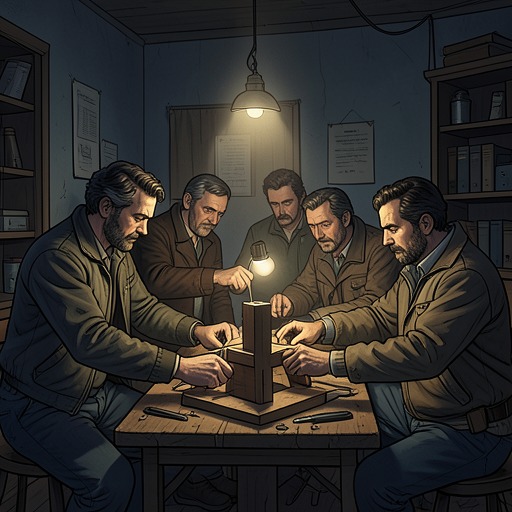
Dorrigo refuses the steak and shares it among the sick
The Narrow Road to the Deep NorthDorrigo Evans’s refusal of a steak is a small but consequential act of leadership in the POW camp: he directs a rare piece of food away from himself and toward the sickest prisoners, making its distribution a public measure of responsibility under scarcity. The choice is not effortless self-denial. Dorrigo wants the meat, recognizes that the men intend it as a tribute, and fears that accepting it would expose the distance between the leader they imagine and the hungry man he is. The steak goes to the hospital, and the kitchen hand carries with it a story of the “Big Fella.”
The steak and its arrival
The steak reaches Dorrigo as his dinner in a tin dixie. It has been obtained through a clandestine chain of actions: a gang led by the Black Prince stole a cow from Thai traders, slaughtered it in the bush, and gave the meat to the camp kitchen after bribing a guard with the eye fillet. The kitchen hand explains that a portion has been cut, grilled, and brought to Dorrigo. In a camp where food is scarce, the meal is not an ordinary serving but the concentrated result of risk, secrecy, and exchange.
Dorrigo’s response begins in his body before it becomes a decision. He is so hungry that his mouth fills with saliva, and he wipes his lips to keep from dribbling as he looks at the steak. Its rough preparation does not diminish its value to him: at that moment, he can think of nothing he wants more. The scene establishes the material force of hunger rather than presenting generosity as an easy virtue. The meal is desirable to the recipient, and the gift has been intended specifically for him.
Refusal and the test of leadership
Dorrigo sees that the kitchen hand is sick and understands that the steak would be extraordinary to him too. He gestures for the man to take it to the hospital and share it among the sickest. The kitchen hand hesitates, explaining that the men want Dorrigo to have it. His hesitation makes the conflict plain: this is both food that the leader could reasonably accept and an opportunity to redirect a coveted resource toward people in greater need.
Dorrigo does not regard the choice as a simple demonstration of goodness. He wonders why he is refusing when he so desperately wants to eat, and knows the prisoners would not have begrudged him the meat. Yet he also understands the gift as a test that needs witnesses and will become a necessary story for the group. The act therefore carries two pressures at once: the practical question of who receives the food, and the symbolic burden of what the leader’s decision will mean to the men who offered it.
The kitchen hand still does not move. Dorrigo fears that, if the steak remains before him, he will seize it and fail the test, revealing himself as the hungry man he is rather than the figure the prisoners expect. His anger turns toward both the men’s unspoken demand and his own weakness. He stands and, in a rage, orders the kitchen hand to take the steak and share it. The force of the command ends the uncertainty; it does not erase the appetite or make the refusal costless.
Distribution under camp scarcity
The episode belongs to a wider pattern in which food and illness shape decisions in the camp. The steak is directed not to the hospital population generally, but to the sickest prisoners. That instruction makes the destination of the gift specific: the meal is to be divided among those whose condition makes them most vulnerable. The kitchen hand, himself sick, is also relieved and pleased by Dorrigo’s decision; he hopes he may taste some of the steak while taking it to the hospital. The order thus redistributes a gift beyond its intended recipient without turning the kitchen hand into a mere courier.
Other details of camp life show how small quantities of food can be guarded, exchanged, and saved. Darky Gardiner keeps a boiled duck egg and a can of condensed milk in his kitbag. Rabbit Hendricks had traded him the egg for a paintbrush that Darky had taken from a Japanese officer’s field satchel; Darky had stolen the milk from a Japanese truck and judged that it could be kept for several days longer. His practice is to take only small amounts, avoiding the kind of theft that would prompt an investigation. These quiet acts of keeping and exchange contrast with the steak’s conspicuous passage from the kitchen to the hospital: survival depends both on private reserves and on decisions about sharing.
The story carried to the hospital
Once Dorrigo makes the order unmistakable, the kitchen hand takes the steak to the hospital, pleased that the colonel has lived up to the prisoners’ image of the “Big Fella.” The men’s tribute is not simply rejected; it is redirected into aid for the sick. The kitchen hand’s response also shows that the decision reaches beyond its immediate recipients. He carries food, but also the account of what Dorrigo did with it, giving the refusal a communal afterlife.
That story matters because Dorrigo knows the act is being watched and remembered. His leadership is tested not by whether he feels hunger, but by what he does while feeling it and by how he handles a gift that others have invested with meaning. The scene does not establish that one meal can alter the camp’s underlying deprivation. Instead, it shows a limited resource being assigned to the sickest, while the leader’s visible choice becomes evidence the prisoners can hold onto. The steak is both food and tribute; Dorrigo’s refusal changes its destination, and the resulting story helps define the responsibility attached to his authority.